

By John Montag, President, Chief Investment Officer & Senior Wealth Manager

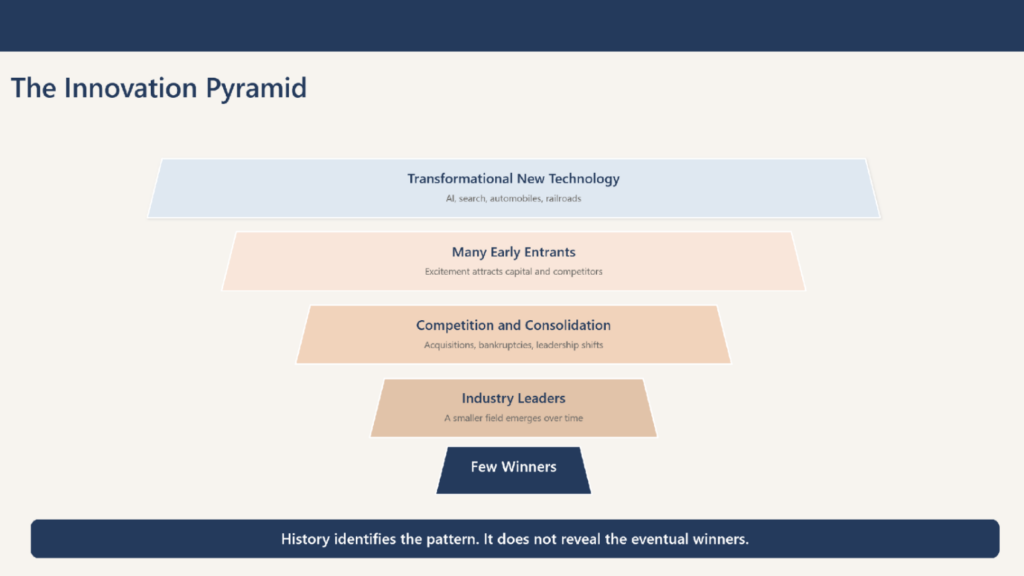
Since 2022, the investment community has been dominated by the world of artificial intelligence. During this time, we have all learned a new vocabulary that includes names such as ChatGPT, Perplexity, and Claude, among others. The entire industry is rapidly evolving.
Looking longer term, history demonstrates new industries regularly appear, bringing new companies and a new vocabulary. It also shows that these industries can take time to evolve and it is common for some companies to succeed while others, which at one point seemed impenetrable, do not.
For illustration, we put three different types of engines — “railroads,” “automobiles,” and “search,” — into Claude and asked for companies in each industry that were broadly known at the start and failed to pass the test of time. Some might sound familiar.
The prompt provided to Claude:
- Provide a list of 10 search engines that existed from the start of the internet through 2005 that no longer exist today. List in order of most searches to fewest and include the years of existence.
- Put this list alongside 10 railroads that were created and eliminated before 1920 and 10 automobile companies that ended before 1945. Include years and notes like the search engines.
- Separate the lists by those companies which were merged and those that ended.
Claude’s reply:
Splitting each list by outcome — Merged/Acquired (absorbed into another company, continued to exist under a different name) vs. Ended/Dissolved (shut down outright, with no surviving successor entity). A few cases are genuinely mixed (acquired, then later shut down anyway); I’ve noted those explicitly rather than forcing a clean split.
Note: Claude AI generated the examples, which were reviewed for reasonableness using publicly available historical references.
Search Engines
Merged/acquired into another company
| Search Engine | Years | Notes |
|---|---|---|
| AltaVista | 1995–2013 | Bought by Overture in 2003, then Yahoo later that year. Continued operating under Yahoo for a decade before being shut down in 2013. |
| GoTo.com | 1998–2001 | Renamed Overture in 2001, later became Yahoo Search Marketing — effectively still exists as an ad-tech lineage inside Yahoo. |
| Magellan | 1995–2001 | Bought by Excite in 1996; disappeared as its own brand well before Excite itself closed the site in 2001. |
| Direct Hit | 1998–2002 | Acquired by Ask Jeeves in 2000; kept running (licensed to HotBot, Lycos, MSN) until formally closed in 2002. |
| WebCrawler | 1994–2001 | Bought by AOL in 1995, then Excite in 1996; original crawler tech retired in 2001, though the name lives on today as an unrelated metasearch aggregator. |
| Excite | 1995–2001* | Portal folded via Excite@Home’s 2001 bankruptcy; assets and brand eventually passed to iWon/Ask/IAC. |
Ended/discontinued outright
| Search Engine | Years | Notes |
|---|---|---|
| Infoseek | 1995–2001 | Disney bought a stake in 1998 and rebranded it “Go” but pulled the plug on Go’s internal search entirely in early 2001. |
| Northern Light | 1997–2002 | Well-regarded for its categorized results but discontinued public search in 2002 to pivot to enterprise-only tools. |
| Snap | 1997–2001 | Became NBCi under NBC’s majority stake but its internal search was abruptly shut down in early 2001. |
| Open Text | 1995–1997 | Yahoo’s original search partner; its consumer search product simply faded out — one of the shortest-lived major engines. |
Railroads (created and eliminated before 1920)
Merged into another railroad
| Railroad | Years | Notes |
|---|---|---|
| Mohawk and Hudson Railroad | 1826–1853 | New York’s first railroad; one of 10 lines consolidated into the new New York Central Railroad in 1853. |
| Camden and Amboy Railroad | 1830–1871 | New Jersey’s first railroad; folded into the United (New Jersey) Railroad and Canal Companies, later part of the Pennsylvania Railroad. |
| Boston and Worcester Railroad | 1831–1867 | Merged with the Western Railroad in 1867 to form the Boston and Albany Railroad. |
| Utica and Schenectady Railroad | 1833–1853 | One of the 10 short lines combined in the 1853 New York Central consolidation. |
| Western Railroad (Massachusetts) | 1833–1867 | Merged with Boston and Worcester in 1867 to form the Boston and Albany Railroad. |
| Erie and Kalamazoo Railroad | 1836–1849 | First railroad west of the Alleghenies; leased to, and effectively absorbed by, the Michigan Southern in 1849. |
| Mad River and Lake Erie Railroad | 1832–1868 | Early Ohio line merged into the Cleveland, Columbus, Cincinnati and Indianapolis Railway. |
| Richmond and Danville Railroad | 1847–1894 | Major Southern trunk line folded into the newly created Southern Railway in 1894. |
| East Tennessee, Virginia and Georgia Railroad | 1869–1894 | Also absorbed into the 1894 Southern Railway consolidation. |
Ended (bankruptcy/dissolution rather than absorption into an existing line)
| Railroad | Years | Notes |
|---|---|---|
| Atlantic and Great Western Railroad | 1853–1880 | Ambitious broad-gauge line through OH/PA/NY; collapsed into bankruptcy and was legally dissolved and reorganized as a brand-new corporation, the New York, Pennsylvania and Ohio Railroad, in 1880 — not simply folded into a pre-existing rival. |
Automobile Companies (ended before 1945)
Merged/acquired into another automaker
| Company | Years | Notes |
|---|---|---|
| Maxwell Motor Company | 1904–1925/26 | Once a top-three U.S. automaker; reorganized by Walter Chrysler directly into the new Chrysler Corporation. |
| E-M-F Company | 1908–1912 | Briefly the #2 U.S. automaker by volume behind Ford (1911); absorbed into Studebaker in 1912. |
| Locomobile Company of America | 1899–1929 | Passed into Durant Motors’ ownership in the 1920s; closed when Durant’s empire collapsed at the decade’s end. |
Ended/ceased operations outright
| Company | Years | Notes |
|---|---|---|
| Electric Vehicle Company | 1897–1907 | Ran the “Lead Cab Trust” electric taxi monopoly; went bankrupt in 1907 amid gas-car competition and legal trouble. |
| Winton Motor Carriage Co. | 1897–1924 | One of the first American companies to sell a motor vehicle commercially; simply closed as it couldn’t compete with mass production. |
| Jackson Automobile Co. | 1902–1923 | Stayed in the founding family the whole time; went out of business in 1923 with no successor. |
| Pope Motor Car Co. (incl. Pope-Waverly) | 1903–1916 | Colonel Albert Pope’s various auto brands; lost out to the cheaper, faster Model T and shut down. |
| Reliable Dayton Motor Car Co. | 1906–1909 | Built the high-wheeler “Reliable Dayton”; often cited as the very first American car brand to go defunct. |
| Anderson Motor Car Co. | 1916–1924 | Rock Hill, SC; undercut by high prices and a failed low-cost aluminum model; stopped manufacturing outright. |
| Elcar Motor Co. | 1915–1934 | Elkhart, Indiana; a longer independent run that still ended in closure during the Depression. |
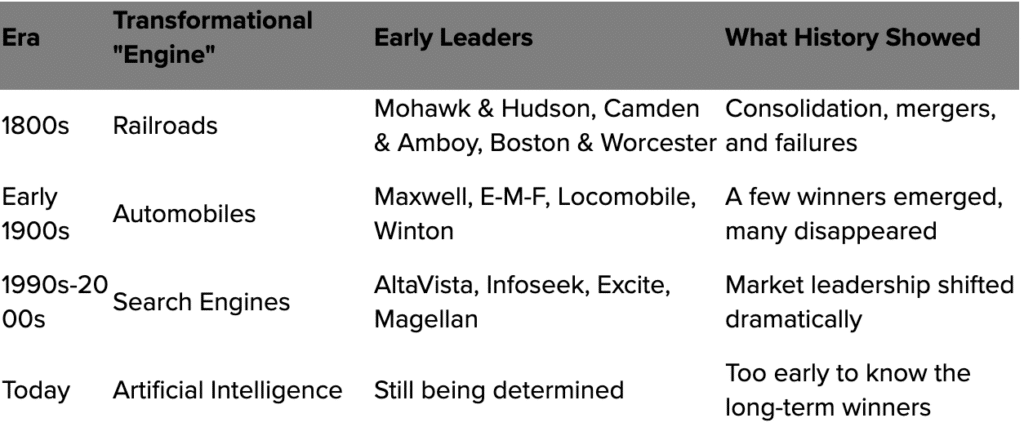
A quick review shows us:
Conclusion
What does this tell us about artificial intelligence?
Perhaps the most important lesson is humility. In the early days of railroads, automobiles, and internet search, it would have been difficult to predict which companies would dominate decades later. Some of the most recognizable names of their time were eventually acquired or consolidated, or disappeared altogether.
This does not diminish the significance of AI. Quite the opposite. Artificial intelligence may prove to be one of the most important technological developments of our lifetime. However, history reminds us that transformative industries often experience waves of innovation, competition, and consolidation before long-term leaders emerge.
As investors, our job is not to predict every winner and loser, but rather to recognize meaningful trends, remain disciplined in the face of excitement and uncertainty, and remember that today’s headlines do not always determine tomorrow’s market leaders.
The AI race has begun. History suggests the finish line may be much farther away than it appears.
The information provided is for illustration purposes only. It is not, and should not be regarded as “investment advice” or as a “recommendation” regarding a course of action to be taken. These analyses have been produced using data provided by third parties and/or public sources. While the information is believed to be reliable, its accuracy cannot be guaranteed. MONTAG employees do not provide legal or tax advice. For specific legal or tax matters, you should consult with your own legal and/or tax advisors.
