

By Hong-Tsun Simon, CFA, Senior Wealth Manager

Above-average economic growth, low unemployment, record earnings, double-digit year-to-date gains in the stock markets. These are all celebratory events, but why has consumer confidence been weakening? The dour mood may possibly be caused by the fact that wage growth has recently been lagging inflation. For the average consumer, stubbornly high fuel and food prices pose real economic challenges.
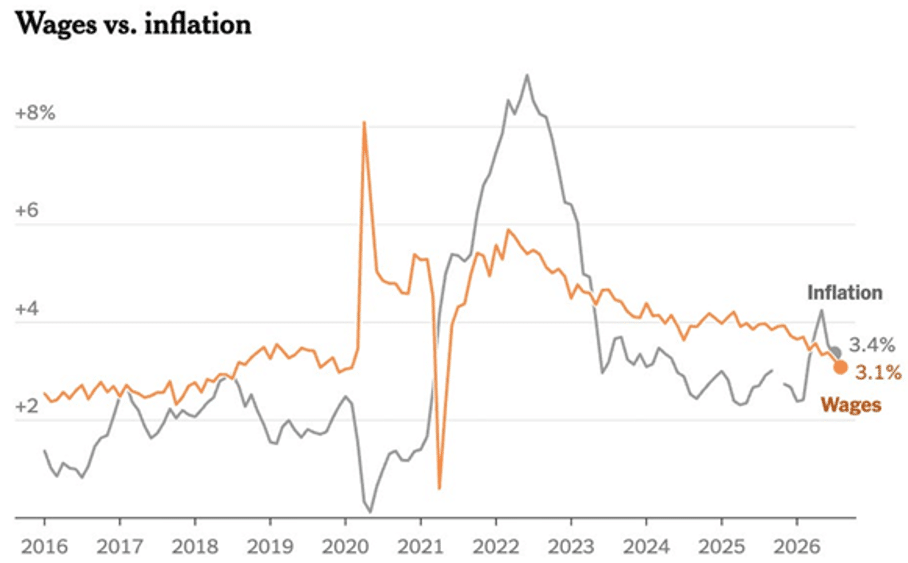
Source: U.S. Bureau of Labor Statistics and The New York Times.
Fortunately for our economy, weakening confidence has not deterred consumer spending. The Commerce Department reported that household spending rose 6.1% year-over-year as of the end of August. Robust AI investments have also helped stage a strong economic backdrop. The Atlanta Fed GDPNow model estimates real economic growth of 3.7% for the third quarter.
Solid economic growth and sticky inflation, unfortunately, have caused the Federal Reserve to take a more hawkish stand, raising short-term interest rates by 0.25% in September. Inflation fears exacerbated by high diesel prices, soaring sovereign debts and issuance of corporate bonds have led to upheavals in the global bond markets. In the US, 10-year treasury yields rose to 5.3%, a 1.1% jump from year-end and the highest since 2002.
As bond prices decrease when interest rates rise, bond investors have suffered losses thus far in 2026:
| 3rd QTR 2026 | Year-To-Date | |
| Aggregate Bond Index | -3.4% | -2.9% |
| S&P Municipal Bond Index | -5.6% | -3.6% |
However, the current yield levels do provide relatively attractive returns. Investors can enjoy 5+% yield by investing in treasury bonds as short as 5 years. As the chart below shows, for investors in the top tax bracket, municipal bonds provide even higher yields.
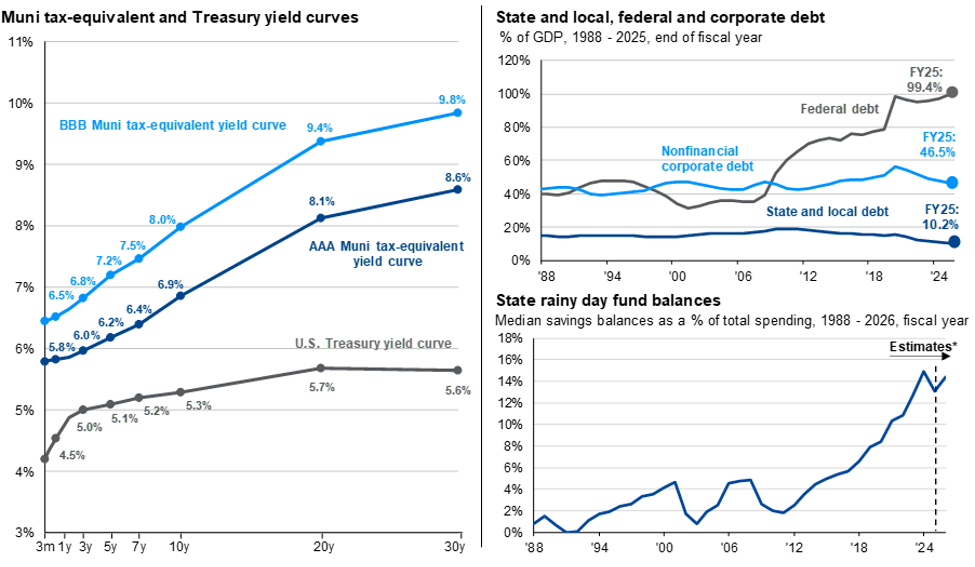
Source: J.P. Morgan Asset Management, Guide to the Markets; underlying sources are identified in the chart.
Treasury Inflation-Protected Securities (TIPS) are also attractively priced. Currently, the real yield on 10-year TIPS is close to 3%, a level not seen since the financial crisis in 2008.
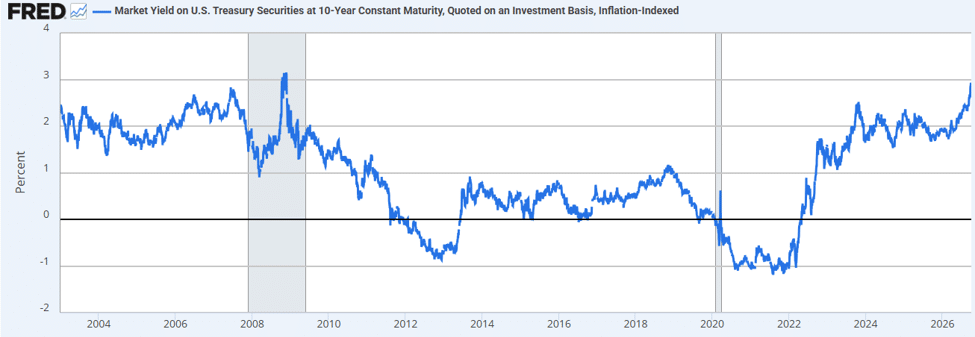
Source: Board of Governors of the Federal Reserve System (U.S.), via FRED®, Federal Reserve Bank of St. Louis, Shaded areas indicate U.S. recessions.
Obviously, all investments carry risks. The US federal debt is currently at 120% of the Gross Domestic Product (GDP), and the Congressional Budget Office estimates the government’s annual budget deficits to be 5-6% of GDP for the next 10 years. Nonetheless, at current yield levels, intermediate bond investments are rather compelling.
Turning to the stock markets, while stocks tend to fare poorly in a rising interest rate environment, the S&P 500 Index bucked the trend and gained 2.3% in the third quarter. Stocks of mid and small companies, which are more interest rate sensitive, posted considerable losses in the past three months. Nevertheless, year-to-date stock market returns remain solid.
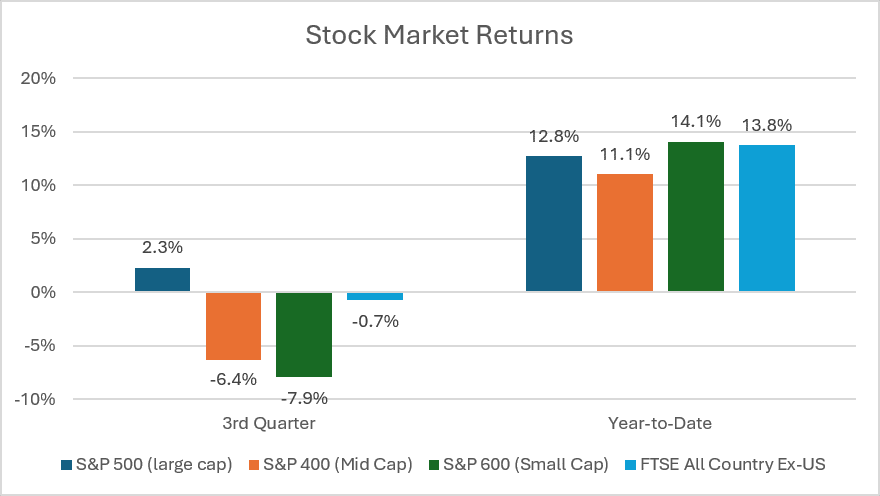
Source: MONTAG Research
The recent strength of the S&P 500 Index has been narrowly driven by energy and big technology stocks. Energy companies continue to benefit from elevated oil prices, while the broader investment landscape remains largely shaped by the AI infrastructure buildout. Earlier this year, AI “picks-and-shovels” companies (memory chips, industrial suppliers to data centers, hardware firms) led the markets. In the third quarter, amidst heightened uncertainties, investors have fled to the new blue chips: big technology companies such as Nvidia, Microsoft and Apple have each gained over 14% in three short months. While the market concentration is unhealthy, fundamentals are strong: earnings growth (~32%) and profits margins (~20%) are at record highs. Much of the earnings improvement reflects extraordinary data center demand for semiconductors and other AI infrastructure-related products. Capital spending by major AI hyperscalers is approaching $800 billion this year and is estimated to be over $1 trillion in both 2027 and 2028. Companies can no longer finance these investments by earnings alone and have increasingly turned to debts and other creative arrangements to help finance the AI buildout.
The growth prospects of the US economy and equity markets are increasingly tethered to AI. Even though AI is a powerful technology, returns on AI investments may fall short of investors’ lofty expectations in the face of rising data center construction costs and regulatory uncertainties. Given the tremendous performance of AI-related stocks in the past few years, a more diversified portfolio may be warranted.
The information provided is for illustration purposes only. It is not, and should not, be regarded as “investment advice” or as a “recommendation” regarding a course of action to be taken. These analyses have been produced using data provided by third parties and/or public sources. While the information is believed to be reliable, its accuracy cannot be guaranteed. MONTAG employees do not provide legal or tax advice. For specific legal or tax matters, you should consult with your own legal and/or tax advisors.
Any securities identified were selected for illustrative purposes only. Specific securities identified and described may or may not be held in portfolios managed by MONTAG and do not represent all of the securities purchased, sold, or recommended for advisory clients. The reader should not assume that investments in the securities identified and discussed were or will be profitable. Nothing in this document represents or should be construed as a solicitation or recommendation to buy or sell any specific security.
There are risks associated with investing in securities. Investing in stocks, bonds, exchange traded funds, mutual funds, and money market funds involve risk of loss. Loss of principal is possible.